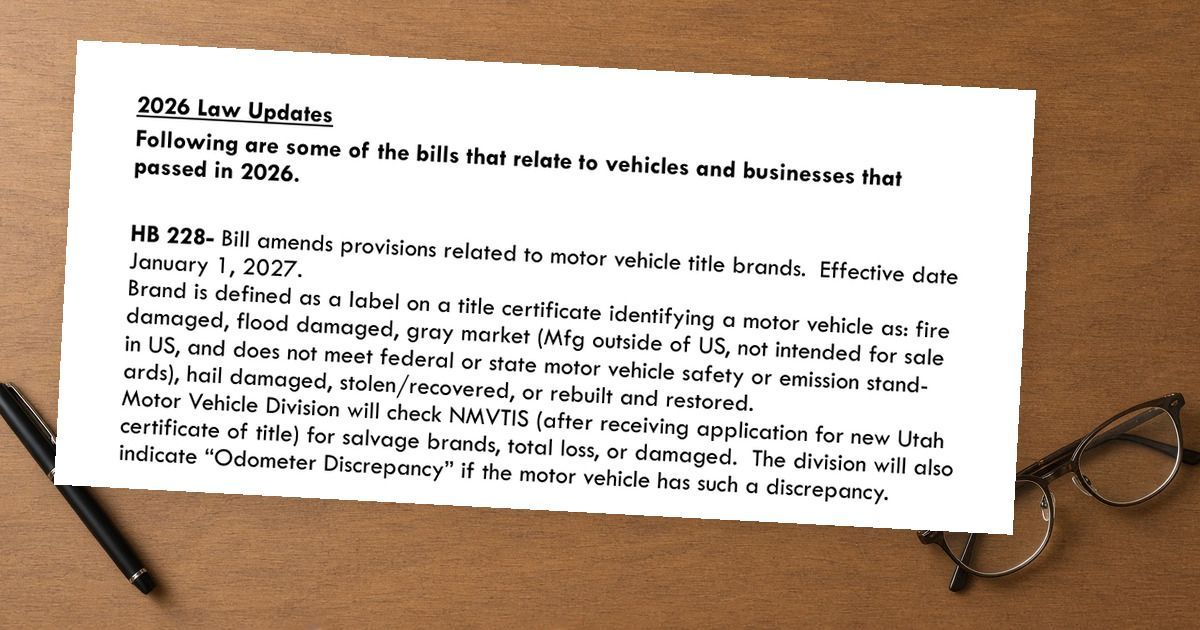
Buy a car from an out-of-state auction, take in a trade with a clean-looking title from another state, and send the paperwork to the DMV. Simple, right? Starting January 1, 2027, that title might come back from Utah with a brand on it, and that changes what the car is worth and what you have to tell your buyer!
That's HB 228, Vehicle Sales Amendments, from the 2026 General Session. MVED flagged it in its April 2026 newsletter, and we read the full enrolled bill so you know exactly what's changing.
What's Changing in a Nutshell
HB 228 does three big things:
- Creates a clear list of title brands with specific definitions.
- Requires the Motor Vehicle Division to check NMVTIS, the national title database, before issuing certain new Utah titles.
- Adds an "Odometer discrepancy" notation on titles when the mileage doesn't add up.
All of it takes effect January 1, 2027.
The New Utah Title Brands
Right now, Utah law brands a salvage vehicle's title as "rebuilt and restored to operation," "in a flood and restored to operation," or "not restored to operation."
Under HB 228, a brand is a label on a title certificate identifying a motor vehicle as one of these:
- Fire damaged: damaged by fire badly enough that an insurance company declared it a total loss.
- Flood damaged: declared a total loss by an insurance company because of immersion in a liquid or contamination with toxic fluid.
- Hail damaged: damaged by falling hail badly enough that an insurance company declared it a total loss.
- Stolen/recovered: reported stolen, recovered, AND declared a total loss by an insurance company.
- Gray market: made outside the U.S., not intended by the manufacturer for sale in the U.S., and not meeting federal or state safety or emissions standards.
- Rebuilt and restored: a vehicle that qualifies under the rebuilt rules below.
A branded title is simply any title labeled with one of those brands.
Notice the pattern? Fire, flood, hail, and stolen/recovered brands all hinge on an insurance company total-loss declaration. If you buy a unit that an insurer totaled, expect a brand.
"Rebuilt and Restored --" Now Tells the Whole Story
Here's a big one for anyone who buys, fixes, and sells. A vehicle that has (or qualifies for) a fire, flood, or hail brand can get a rebuilt and restored brand once it's rebuilt or restored well enough to be safely operated on a highway.
But the title won't just say "rebuilt." The law requires it to read "Rebuilt and Restored --" followed by the brand the vehicle had before:
- Rebuilt and Restored -- Fire
- Rebuilt and Restored -- Flood
- Rebuilt and Restored -- Hail
- Rebuilt and Restored -- Stolen
So your buyer, their lender, and their insurance company will see exactly WHY the vehicle was branded.
Gray market vehicles get their own path. One that's altered to meet federal and state safety standards AND passes a safety inspection under Utah Code 53-8-205 can get a compliant gray market brand.
The NMVTIS Check: No More Title "Washing"
NMVTIS is the National Motor Vehicle Title Information System, the federal title database run by the American Association of Motor Vehicle Administrators.
Today, Utah's title statute only requires checking a VIN against Utah's registration records and the stolen-vehicle indexes. Starting January 1, 2027, under Utah Code 41-1a-513, when someone applies for a new Utah title and has:
- no certificate of title for the vehicle, OR
- a certificate of title from another state,
the Motor Vehicle Division must check the VIN against NMVTIS. If a state reporting to NMVTIS shows the vehicle as a salvage brand, a total loss, or damaged, the Division follows Utah's branded-title process.
What it means for you: A clean-looking out-of-state title is NOT a guarantee anymore (honestly, it never was). If another state reported the vehicle as salvage or a total loss, Utah will catch it. Pull a history report that uses NMVTIS data before you buy, not after you've reconditioned the car and priced it like a clean unit!
"Odometer Discrepancy" on the Title
HB 228 also tells the Division to print "Odometer discrepancy" on the title when the vehicle has one. Under the bill, an odometer discrepancy means the written odometer disclosure statement (Utah Code 41-1a-902) shows the odometer doesn't match the actual miles or kilometers the vehicle was driven.
What it means for you: Your odometer statements matter more than ever. Fill them out carefully, check the numbers against the title and the vehicle, and don't sign off on a disclosure you can't back up. A sloppy statement can follow that VIN onto the next title.
Your Disclosure Duties Haven't Gone Anywhere
HB 228 doesn't change Utah's existing disclosure rules in Utah Code 41-1a-1004, but the new brands make them easier to trip over:
- Before the sale, if a salvage certificate or branded title has been knowingly issued, or the vehicle was knowingly declared a total loss by an insurance company, the seller must give the buyer written notice. For salvage and total-loss vehicles, that notice follows the format in Utah Code 41-1a-1005.3.
- In your ads, a vehicle with a salvage certificate or branded title must say so, and an insurer-declared total loss must disclose that too. The disclosure must be at least as prominent as the vehicle description and use the words "salvage certificate," "branded title," or "insurer declared total loss."
The law has narrow exceptions, such as certain salvage auction sales and stolen/recovered total losses that don't meet the definition of a salvage vehicle. Don't count on an exception unless you're sure it fits.
Your January 1 Game Plan
- ✅ Check NMVTIS-based history on every out-of-state or no-title unit BEFORE you buy
- ✅ Learn the new brand names so you can explain a branded title to a customer
- ✅ Update your listing templates to show "branded title" or "salvage certificate" when it applies
- ✅ Double-check every odometer statement
- ✅ Keep your written branded-title notices with the deal file
Stay Ahead With EasyMVED
Title rules change, and MVED expects you to keep up! Our Annual Dealer License Renewal Course covers the latest state and federal regulations, 100% online and at your own pace. Getting your first license? Our Utah MVED approved 8-hour Auto Dealer Orientation Course gets you ready FAST!
Coming up next: more from MVED's 2026 newsletters, including the new auction license and consignment rules, electric bike and scooter sale disclosures, lifetime trailer registration, and the TC-928 Monthly Report of Sale. Stay tuned!
Sources
- H.B. 228, Vehicle Sales Amendments (2026 General Session), Enrolled Copy: https://le.utah.gov/Session/2026/bills/enrolled/HB0228.pdf
- Utah Code 41-1a-1004, Certificate of title, salvage vehicles, buyer notification (current and effective 1/1/2027 versions): https://le.utah.gov/xcode/Title41/Chapter1A/41-1a-S1004.html
- Utah Code 41-1a-513, Examination of registration records, national title records (effective 1/1/2027 version): https://le.utah.gov/xcode/Title41/Chapter1A/41-1a-S513.html
- Utah Code 41-1a-1005.3, Resale of salvage and total loss vehicles: https://le.utah.gov/xcode/Title41/Chapter1A/41-1a-S1005.3.html
- Utah MVED, April 2026 Newsletter ("2026 Law Updates"): https://files.tax.utah.gov/mved/newsletter/2026-04-newsletter.pdf
- Utah DMV, Salvage Vehicles and Branded Titles: https://dmv.utah.gov/titles-overview/salvage-vehicles/
- National Motor Vehicle Title Information System (NMVTIS): https://vehiclehistory.bja.ojp.gov/